Showing posts with label Parables. Show all posts

Friday, April 25, 2008

Blind Devotion? (Luke 14:26)

A few weeks ago, someone asked about how to interpret Luke 14:26, "If anyone comes to me and does not hate his own father and mother and wife and children and brothers and sisters and even his own life, he cannot be my disciple." Is this blind devotion? If so, isn't blind devotion dangerous - kind of Hitlerish?

The devotion that Jesus called for is radical, but not blind. Note the next few verses: "For which of you, when he wants to build a tower, does not first sit down and calculate the cost to see if he has enough to complete it? Otherwise, when he has laid a foundation and is not able to finish it, all who see it will begin to mock him." Jesus then tells a similar parable about a king preparing for war (Luke 14: 28-32).

Jesus' point is this: we must enter the kingdom open-eyed, recognizing what it may cost. This is much like the parables of the pearl and the buried treasure in Matthew 13:44-46. It is only rational to sell everything one has to buy a property that has a fortune buried in it. In the same way, it makes sense to be willing to pay anything to gain the kingdom.

What about paying the cost of hating your family? In the parallel passage in Matthew 10:37-38, Jesus says "The one who loves father or mother more than me is not worthy of me; and the one who loves son or daughter more than me is not worthy of me." In Matthew's context, it is clear that Jesus is warning about the division that can come in a home when one person becomes a disciple of Jesus and others do not. In many cases, new believers can feel rejected, or even be expelled from their families. In such cases, Jesus says, one must decide which relationship to keep. In Luke 14 and Matthew 10, Jesus is saying that if you have to choose, choose him. Ideally, we don't have to choose - our non-believing family members tolerate our faith, or come to also trust in Jesus. But if they force us to make a choice - choose Jesus, every time.

Both passages remind us that the same is true of life itself. In most cases, the non-believing world allows us to keep living if we become Christians. But if it forces a choice upon us of living without Jesus or dying with Jesus - choose Jesus, every time. Easy to say, not so easy to do.

The picture: Luke 14:26, from The Brick Testament.

Tuesday, April 8, 2008

Kingdom for the Birds II

In an earlier post, I wrote about Jesus' parable of the mustard seed (Matthew 13:31-32). The kingdom, Jesus said, was like a tiny mustard seed, hidden in the ground, that would grow into the largest garden plant. Jesus described the birds nesting in its branches to connect his parable with a similar parable about a kingdom from Ezekiel 17.

Matthew 13 has seven parables. Four of the them teach that the kingdom of God is hidden yet valuable; three explain why only some respond positively to the message of the kingdom; all of them invite us to seek the kingdom.

Why did Jesus teach this set of parables? Just before, the Pharisees make a formal decision about Jesus: "This man casts out demons only by Beelzebul, the ruler of demons" (Matthew 12:24). In the remainder of Matthew 12, Jesus denounces their claim and the hearts that would produce such twisted logic. In Matthew 13, Jesus' parables explain why the Pharisees and others rejected the kingdom (bad soil, weeds, trash fish) and why Jesus' kingdom didn't look like much yet (mustard seed, yeast, pearl, treasure).

There is comfort and challenge yet in these parables. Comfort, because the kingdom still looks small and weak today, and many reject it. We kingdom citizens and kingdom soldiers know our weakness (when we are honest) and we mourn at the failures around us and in us. Challenge, because the parables call us to recognize the value of the kingdom and seek it with all our hearts.

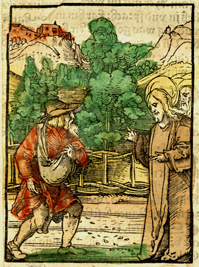
The picture: Parable of the Sower, from Das Plenarium oder Ewangely Buoch, 1516. Courtesy of the Digital Image Archive, Pitts Theology Library, Candler School of Theology, Emory University.

Friday, April 4, 2008

The Kingdom for the Birds? (Matthew 13:31-32)

"The kingdom of heaven is like a mustard seed, which a man took and sowed in his field; it is the smallest of all (garden) seeds, but when it is grown, it is larger than all the herb plants, and becomes a tree, so that the birds of the sky come and nest in its branches." (Matthew 13:31-32)

Why the birds? Some see the birds as symbolic of Satan, since the birds are "the evil one" in Jesus' first parable (Matt 13:19). However, symbols don't mean the same thing every time they occur. In this case, Jesus is drawing on an Old Testament image to enrich his parable. The picture of a great tree that provides a haven for birds is used three times in the OT (Ezek 17:23, 31:6; Dan 4:12). In each case, the tree is a mighty kingdom and the birds depict the majesty and blessings of that kingdom.

At first look, Jesus could be alluding to any one of these three OT passages. His wording does not perfectly match any of the three passages, which is quite normal when the NT refers to the OT. A closer look shows us that Jesus is probably echoing Ezekiel 17, which contains a provocative parable about the fall of the royal family of Israel in 586 BC. The family is a vine, which is uprooted and withers because of its unfaithfulness to its gardener. But one day, God will take a tiny twig, plant it in Jerusalem, and it will become a great cedar, "and birds of every kind will nest... in the shade of its branches."

Many Jews at the time of Jesus believed that Ezekiel 17:23 described the rule of the messianic king, ruling over a restored Jewish kingdom. The translators of the LXX (the Greek Old Testament) called the cedar "he" to make it clear that the cedar is a person (in Greek, cedar is a feminine word); and the Ezekiel Targum (an Aramaic translation, possibly from the late first century) explained that the cedar was a king from the line of David, and the birds were the "humble who dwell in the shade of his kingdom."

So Jesus ends his parable with an allusion to Ezekiel's older parable. Ezekiel's tiny twig would become a mighty cedar. Jesus' mustard seed would become a great tree. The dusty rabbi from Nazareth and his nondescript band of disciples would become a mighty kingdom, providing blessings to all who recognize the majesty of the king and his kingdom.

The picture: Jesus Teaches His Disciples, in Das Plenarium oder Ewangely Buoch, printed 1516. Courtesy of the Digital Image Archive, Pitts Theology Library, Candler School of Theology, Emory University.