Showing posts with label Ezekiel. Show all posts

Thursday, March 19, 2009

The Good Shepherd (John 10)

I find this passage to be one of the most fascinating in John. It's difficult for me to write a short blog post on John 10, since I wrote a lengthy chapter on it several years ago! But I'll try to pick out just a few of the significant gems in the passage.

1) Jesus starts this sermon angry at abusive leadership. In John 9, Jesus heals a blind man on the Sabbath. The leadership of Jerusalem (Pharisees and priests) ought to respond by thanking God and helping the blind man start a new life. Instead, they insult him and expel him from the synagogue since he insists that his healer must be from God. John 9:35-41 is a pivot passage - it wraps up the conflict of John 9, but also begins Jesus' denunciation of the Pharisees and Temple leadership. John 10 is thus both a defense of Jesus' status as the true leader of Israel and an attack on the abusive leadership of Jerusalem.

2) It's common for Christians to quote John 10:10, "The thief comes only to kill and steal and destroy" as a reference to Satan. However, all the "bad guys" in this chapter are the leaders of Jerusalem, not Satan. NT scholar Craig Evans points out that in other Jewish literature of this period, "thief" was a common term used for the priestly leadership of Jerusalem.

3) In John 10:1-9, a number of distinctive phrases are intended to remind the reader of Numbers 27:15-23, the appointment of Joshua. These similarities are even more obvious when you read them in Greek. in Num 27, Joshua is appointed as the next shepherd of the nation. His appointment is affirmed by Moses and by the high priest before all the people of Israel. By referring to this passage, Jesus compares himself to Joshua (who has the same name as Jesus, after all), and suggests that the priests and Pharisees of his time should also affirm Jesus' leadership.

4) In John 10:8-16, a number of distinctive phrases are intended to remind the reader of God's condemnation of the leaders of Israel in Ezekiel 34. In Ezek 34, God is the good shepherd, and all the other leaders of Israel are described as bad hired shepherds who steal, kill, and scatter the sheep. Ezekiel 34 also talks about God's appointment of "David" as a good shepherd. Jesus' use of this passage from Ezek 34 shows that he was claiming the status of both good shepherds from Ezek 34 - David and God.

Like most other scenes in John, this passage reveals Jesus as the source of life to those who believe. This passage also contains a warning: the Temple leadership (both political and spiritual) of Jesus' day cannot provide life, but in fact steals life. As John most likely wrote after the destruction of the Temple, he intended this to be a timeless warning: no other leader can provide genuine life as Jesus can.

Monday, February 2, 2009

Jesus' First Disciples in John (John 1:19-51)

In John 1:19-51, John the Baptist (JTB) and the first five disciples all testify about the identity of Jesus. This passage is primarily about the identity of Jesus as anointed ruler, teacher, and sacrifice. The quality of the first followers’ discipleship is revealed by its basis in faith (even with no "signs" yet) and its expression in open testimony to others.

Random observations on John 1:19-51:

John the Baptist denies being the Christ, the Prophet, or Elijah. The reason for the first denial is obvious. He denies the second title because it is a reference to the “Prophet like Moses” (Deut 18:15-18; cp. John 7:40-41). He denies the third title, perhaps because in John, Jesus fills many of the Elijah roles (more on this below, and in John 2, 4, and 6).

Titles/Roles for Jesus: The Lord; Lamb of God (2x); The one who takes away the sins of the world; The one who comes after John / came before John (2x); The one who baptizes with the Holy Spirit; The Son of God (2x);Rabbi / Teacher (2x); Messiah / Christ; The one whom Moses and the Prophets wrote about; Jesus, son of Joseph, of Nazareth; King of Israel. This might count as seven titles for Jesus, plus four descriptive phrases; but in John, we have to watch the tendency to spot 7s whenever we wish, conveniently stopping our count at seven.

Seeing: John sees Jesus; “Look! The Lamb of God”; “I have seen the Spirit descending”; “I have seen and testified”; and seeing Jesus, he said; “Look! The Lamb of God”; turning and seeing them, he said…; “Come, and you will see”; Then they came and saw; When Jesus saw [Simon Peter]; Philip said, “come and see” ; Jesus said about Nathanael, “Look , an Israelite indeed” ; “I saw you under the fig tree”; “You will see greater things”; “you will see the heavens opened.” Greek note: John uses four essentially synonymous words for seeing in this chapter: blepo, emblepo, horao, theaomai.

Seeking/finding (zeteo / heurisko): Jesus says to them “What do you seek?” ; Andrew first finds his own brother Peter; “We have found the Messiah” ; Jesus finds Phillip; Phillip finds Nathanael; “We have found the one that Moses wrote about.”

Following (akoloutheo): The two disciples heard John and followed Jesus; Jesus saw them following; Andrew was one of the two who followed Jesus; Jesus said to Phillip, “Follow me.” Note pattern: JTB speaks, Andrew (and John?) follow; Andrew speaks, Peter follows; Jesus speaks, Phillip follows; Phillip speaks, Nathanael follows.

Misunderstanding: Phillip and Nathanael think that Jesus is from Nazareth, but Jesus is from Bethlehem (a private joke between John and his readers, see also Jn 7:41-42, 52). More importantly in John, Jesus is from God more than he is from any town. The disciples incompletely (but not incorrectly) understand Jesus – all their titles for Jesus refer to his kingly and teaching roles. Only JTB knows that Jesus will die for sins.

Jesus reveals God: “ You will see the heavens opened” recalls the vision of God in Ezek 1, and “angels ascending and descending” recalls the vision of God in Gen 28. The disciples will experience God through Jesus. Some irony here, since Jn 1:18 claims that no one has ever seen God, and Jn 1:51-52 alludes to two OT visions of God.

Other OT allusions:
  • “Spirit remaining on him” in Jn 1:32 alludes to Isa 11:2, “The Spirit of God will rest upon him,” referring to the Spirit’s empowerment of the messianic Branch (Isa 11:1-2). Perhaps it also reminds us of David, on whom the Spirit remained, unlike Saul.
  • The disciples ask where Jesus is staying; Jesus says “come and see” (Jn 1:39, 46). The king of Aram tells his servants to “come and see” where Elisha is staying (2 Ki 6:13 LXX).
  • Jesus finds Phillip and says “follow me” (Jn 1:43). Elijah finds Elisha and Elisha says “I will follow you” (1 Ki 19:19-20).

These last two are very subtle allusions, and are open to challenge. But since John often compares Jesus to Elijah / Elisha, it is possible that John intended his readers to see these allusions.

The picture: Philip brings Nathanael, painted by one of the Mafa tribe of North Africa.

Thursday, October 2, 2008

Restoring a Fisherman (John 21:15-17)

In a recent post, I pointed out that we should not read too much into the variation of Greek words (such as agape and phileo) in the account of Simon Peter's restoration in John 21:15-17. The passage is very poetic, and uses a number of synonymous words for stylistic reasons.

One of my beefs with Bible professors (and I am one of them) is that sometimes we take a perverse delight in skewering common misinterpretations of Scripture, but then we leave people with nothing. We take away meaning, rather than adding understanding. My goal, as a professor who regularly skewers bad interpretation, is to replace bad interpretation with better - and that better interpretation is (or ought to be) more attractive because it is truer and more powerful.

In John 21:15-17, there is much to learn after we remove bad interpretation. First, we find seven disciples fishing. Since fishing was not primarily for recreation, it seems that Peter is returning to his old career. Nothing wrong with fishing for a living - but Peter had been called to be a full-time disciple of the rabbi. Peter probably felt that his failure disqualified him to serve or lead.

The miraculous catch of fish in John 21 is a reminder of Peter's initial call to be a "fisher of men." (Nerd note: this version of Peter's initial call is found only in Luke 5:1-11, and not in John. But I think that we have here an example of what Johannine scholars call "interlocking," where John refers to things that the readers would only know if they were familiar with the Synoptic gospel stories, and especially Luke). The repeat of the miracle puts Peter in a state of mind to be re-summoned to service.

The miracle also contains a minor allusion to an OT prophecy about the new covenant age. Ezek 47:1-12 describes a river of healing water flowing from the Temple (compare to John 7:37-39, where the river comes from Jesus), which bring a multiplication of fish. Some ancient rabbinic sources specifically located Ezekiel's multiplication of the fish at the Sea of Tiberias (cp. John 21:1).

Jesus further prepares Peter for restoration by cooking breakfast over an anthrakia, a charcoal fire, perhaps in a metal brazier. The only other time that anthrakia occurs in the Bible is in John 18:18, where Peter denied that he knew Christ three times. This explains the repetition in John 21. Peter now has the chance to do it right. Just as three times he denied Jesus before enemies, he now can affirm his love for Jesus three times before friends.

Jesus' goal is to restore Peter to self-sacrificial service, to help him become a shepherd like Jesus (see John 1o). Part of the reason that Peter had denied Jesus was that he had wanted to die with Jesus, and followed Jesus into a place where he was unable to remain loyal. He was more concerned with his own personal loyalty to Jesus, and less concerned with shepherding his brothers.

Peter took his re-appointment to shepherding seriously. Thirty years later, he wrote this to church leaders: "Shepherd the flock of God among you, not grudgingly, but willingly, as God wants you to... be examples to the flock. Then when the Chief Shepherd appears, you will receive a glorious and unfading crown." (1 Pet 5:2-4)

Tuesday, April 8, 2008

Kingdom for the Birds II

In an earlier post, I wrote about Jesus' parable of the mustard seed (Matthew 13:31-32). The kingdom, Jesus said, was like a tiny mustard seed, hidden in the ground, that would grow into the largest garden plant. Jesus described the birds nesting in its branches to connect his parable with a similar parable about a kingdom from Ezekiel 17.

Matthew 13 has seven parables. Four of the them teach that the kingdom of God is hidden yet valuable; three explain why only some respond positively to the message of the kingdom; all of them invite us to seek the kingdom.

Why did Jesus teach this set of parables? Just before, the Pharisees make a formal decision about Jesus: "This man casts out demons only by Beelzebul, the ruler of demons" (Matthew 12:24). In the remainder of Matthew 12, Jesus denounces their claim and the hearts that would produce such twisted logic. In Matthew 13, Jesus' parables explain why the Pharisees and others rejected the kingdom (bad soil, weeds, trash fish) and why Jesus' kingdom didn't look like much yet (mustard seed, yeast, pearl, treasure).

There is comfort and challenge yet in these parables. Comfort, because the kingdom still looks small and weak today, and many reject it. We kingdom citizens and kingdom soldiers know our weakness (when we are honest) and we mourn at the failures around us and in us. Challenge, because the parables call us to recognize the value of the kingdom and seek it with all our hearts.

The picture: Parable of the Sower, from Das Plenarium oder Ewangely Buoch, 1516. Courtesy of the Digital Image Archive, Pitts Theology Library, Candler School of Theology, Emory University.

Friday, April 4, 2008

The Kingdom for the Birds? (Matthew 13:31-32)

"The kingdom of heaven is like a mustard seed, which a man took and sowed in his field; it is the smallest of all (garden) seeds, but when it is grown, it is larger than all the herb plants, and becomes a tree, so that the birds of the sky come and nest in its branches." (Matthew 13:31-32)

Why the birds? Some see the birds as symbolic of Satan, since the birds are "the evil one" in Jesus' first parable (Matt 13:19). However, symbols don't mean the same thing every time they occur. In this case, Jesus is drawing on an Old Testament image to enrich his parable. The picture of a great tree that provides a haven for birds is used three times in the OT (Ezek 17:23, 31:6; Dan 4:12). In each case, the tree is a mighty kingdom and the birds depict the majesty and blessings of that kingdom.

At first look, Jesus could be alluding to any one of these three OT passages. His wording does not perfectly match any of the three passages, which is quite normal when the NT refers to the OT. A closer look shows us that Jesus is probably echoing Ezekiel 17, which contains a provocative parable about the fall of the royal family of Israel in 586 BC. The family is a vine, which is uprooted and withers because of its unfaithfulness to its gardener. But one day, God will take a tiny twig, plant it in Jerusalem, and it will become a great cedar, "and birds of every kind will nest... in the shade of its branches."

Many Jews at the time of Jesus believed that Ezekiel 17:23 described the rule of the messianic king, ruling over a restored Jewish kingdom. The translators of the LXX (the Greek Old Testament) called the cedar "he" to make it clear that the cedar is a person (in Greek, cedar is a feminine word); and the Ezekiel Targum (an Aramaic translation, possibly from the late first century) explained that the cedar was a king from the line of David, and the birds were the "humble who dwell in the shade of his kingdom."

So Jesus ends his parable with an allusion to Ezekiel's older parable. Ezekiel's tiny twig would become a mighty cedar. Jesus' mustard seed would become a great tree. The dusty rabbi from Nazareth and his nondescript band of disciples would become a mighty kingdom, providing blessings to all who recognize the majesty of the king and his kingdom.

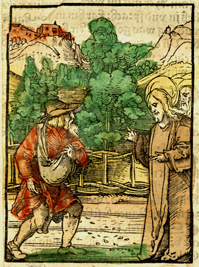
The picture: Jesus Teaches His Disciples, in Das Plenarium oder Ewangely Buoch, printed 1516. Courtesy of the Digital Image Archive, Pitts Theology Library, Candler School of Theology, Emory University.