Showing posts with label Matthew. Show all posts

Tuesday, December 22, 2009

Herod Remembered

Herod wanted to be remembered for something else.

He wanted to be remembered as the man of influence - friend of Julius Caesar, Mark Antony, and Augustus. He wanted to be remembered as a political prodigy: governor of Galilee by age 25, Roman governor of Coele-Syria, tetrarch of Judea. He wanted to be remembered as "King of the Jews" - a title bestowed on him by a vote of the Roman Senate, despite the fact that he was neither royal nor Jewish. He wanted to be remembered as a successful commander: he defeated the brigand Ezekias in his youth, and he commanded a Roman legion to reclaim Israel from the Parthian empire.

Herod wanted to be remembered for his public works. He had a thousand Levites trained as stone masons to totally refurbish the Temple. He built aqueducts, baths, fortifications, hippodromes, theatres, amphitheatres and gymnasiums, not only in Israel but in other nations. He built a shrine to Augustus and allowed a statue of himself to be erected in another temple - not something that endeared him to his Jewish subjects. He built the port and city of Caesarea Maritima, still an amazing feat.

Herod wanted to be remembered for his generosity towards his subjects. He twice reduced taxes, once by one-third and once by one-fourth. During a famine, Herod sold the silver in his palace to provide food for his people.

Herod wanted to be remembered for his protection of Jews throughout the Roman Empire. Because of Herod's influence with Augustus, Jews throughout the Empire gained official protection: they could not be compelled to appear in court on the Sabbath; they were exempt from having to participate in Roman religious rituals; and shipments carrying their annual head-tax to the Temple were protected by Roman law and Roman might.

But Herod is remembered for none of these things by most people. Instead, Herod is remembered only for how he responded to the baby Messiah. His brutality in killing the baby boys of Bethlehem was unfortunately entirely consistent with his character. Although Herod killed many, those who could make a more legitimate claim to kingship than Herod were his special targets. He killed most of the remnants of the previous royal dynasty, the Hasmoneans, including his own wife and sons. It is not surprising that Herod would also try to kill the offspring of an even older dynasty, the Son of David.

By the way, don't get your Herods confused. Herod the Great was king of Israel (40-4 BC), and is famous for trying to kill the baby Jesus (Matt 2:16). Herod Antipas, his son, was tetrarch of Galilee (4 BC - AD 39), and is famous for executing John the Baptist (Matt 14:3-12) and interrogating Jesus (Luke 23:6-12). Herod Agrippa I, grandson of Herod the Great, ruled over Israel (AD 37-44), and is famous for executing James the son of Zebedee and being eaten by worms (Acts 12). Four other family member show up in the NT: Archelaus, ethnarch of Judea, son of Herod the Great (4 BC-AD6, Matt 2:22); Herodias, granddaughter of Herod the Great and wife of Herod Philip and Herod Antipas (Matt 14:1-12); Herodias' daugher; and Herod Agrippa II, tetrarch of Iturea (Acts 25:13-26:32).

The picture: a coin minted under Herod the Great.

Tuesday, December 15, 2009

Christmas Myths

Here is a list of my favorite Christmas myths - traditional parts of the Christmas story that we assume to be true, but they are not found in our two accounts of Jesus' birth in Matthew and Luke.

Mary rode on a donkey and Joseph walked to Bethlehem? No donkey mentioned in the Bible. Maybe they had one, maybe not. The reason that a donkey and ox are always depicted in manger scenes goes back to the middle ages, when the two animals were placed in the scene as symbols of Isaiah 1:3.

Mary gave birth the night that they arrived? "While they were there, the days were completed for her to give birth" (Luke 2:6). Sounds like they arrived some time before. They were smart enough not to make a 9-month-pregnant woman travel!

Joseph delivered the baby? Almost impossible in their culture. Joseph is from Bethlehem (Luke 2:3-4), so he has plenty of extended family. His female relatives likely served as midwives.

No room in the inn? This myth is understandable, since our Bibles say "inn" (Luke 2:7). However, the Greek word is kataluma, which more likely means "guest room" (Luke 22:11, Mark 14:14). Jews in general did not stay in inns, and it is unlikely that Bethlehem had an inn. Since Joseph had family in Bethlehem, Luke probably meant that there was no space in their guest room. Perhaps the family did not give Joseph and Mary their best reception, since Mary got pregnant before they got married?

Jesus was born in a stable? No stable is mentioned in the Bible. "She laid him in a manger" (Luke 2:7). Peasant homes sometimes had feeding troughs dug into the dirt. Some animals were kept in the house for safety. They probably kicked out the animals and used the manger for the baby because it was convenient and warm. Perhaps this was a "sign" to the shepherds because it showed that the Messiah was born as a peasant, rather than in the Herodium, Herod's nearby palace that overshadowed Bethlehem. (By the way, Herod's tomb was discovered in the Herodium just a few years ago).

Swaddling clothes are for dead bodies, symbolizing the coming death of Christ? No, the Greek word sparganao (Luke 2:7) merely means to wrap in cloths, and is not used elsewhere to refer to the cloths for dead bodies.

The Star of Bethlehem was some astronomical phenomenon? The star described in Matthew 2 does thing that real stars don't do - like change positions and hover over a particular house. Stars were regarded by ancients as supernatural, and that seems to be what Matthew is saying about this particular star.

Three kings from Persia came to visit? Matthew doesn't give a number. And they were magoi, astrologers and advisors to kings, not kings themselves. They may have been from Persia. In Greek "the east" is the same word as Anatolia, so it is possible that they are wise men from Anatolia rather than from Persia - but that's not certain (see Ben Witherington's blog on this).

The wise men came that night? We don't know exactly when they arrived, but it was some time between one month and two years after his birth (Matthew 2:16). The magoi came to a house, not a stable (Matthew 2:11). It must have been at least a month later, because Joseph was still poor when Jesus and Mary were presented at the Temple (after 33 days, Lev 12:1-3). They offered two turtle-doves instead of a lamb, which was only allowed in the case of poverty (Lev 12:6-8). If the wise men had already come, then Mary and Joseph would not have been poor.
Medieval and renaissance art often portrayed the shepherds and wise men at the stable, but that is because artists of the time would put all the related events in one scene with no concern for chronology. Nativity scenes sometimes included the annunciation, although that happened nine months earlier.

Gold, frankincense and myrrh symbolize... ? Various versions of this Christmas myth circulate - that they symbolize kingship, deity and death, or prophet, priest and king. But all three were appropriate gifts for a king, and were very expensive.

Herod killed hundreds of babies? Population estimates of Bethlehem make it likely that Herod's soldiers killed a dozen or so baby boys. Those who doubt that Herod was evil enough to do this should read Josephus' account of Herod's last years. In his attempts to preserve his throne, Herod killed court members, wives and sons. Caesar Augustus famously said about Herod that it was better to be his pig (hus) than his son (huios). On his death bed, Herod ordered the execution of every tribal patriarch in his realm to make sure that all would mourn at his funeral (fortunately, this command was not carried out).

Jesus was born on December 25, AD 1? The exact date of Jesus' birth is unknown, but was not December 25. The first time his birthday was mentioned was in the late second century, and it was given as November 18, but that's not certain either. Jesus must have been born before March of 4 BC, because that's when Herod the Great died. 5 BC seems likely, although maybe it was as early as 7 BC.

The picture: The Vigil of the Shepherds, by Benozzo Gozzoli, 1459.

Wednesday, July 29, 2009

Jesus' Prayer for Lazarus (John 11)

As Jesus stands before the open tomb of his dead friend Lazarus, he says an interesting prayer: "Father, I thank you because you heard me. I know that you always hear me, but I said it because of the crowd standing around me, so that they may believe that you sent me."

The phrase in italics is from Ps 118:21 (117:21 in the LXX numbering). The psalmist says "I thank you because you heard me, and because you have become my savior/salvation." Remember that the Psalms served Israel as both a song book and a prayer book. Even a barely educated (but pious) first-century Jew would be able to sing most the Psalms from memory.

Why does Jesus refer to Ps 118 while praying? First, this Psalm is a central part of Jesus' self-understanding. The following verse, "The stone which the builders rejected has become the chief corner stone" (Ps 118:22) is quoted several times in the New Testament to describe how Jesus was rejected by the leaders of Israel but chosen by God (Matt 21:42-44, Acts 4:10-11, 1 Pet 2:4-7). Just a few weeks after the raising of Lazarus, the crowds at the Triumphal Entry acclaim Jesus as king (and therefore Messiah) by singing Ps 118:25-26 to him, "Hosanna! (Save!) Blessed is he who comes in the name of the Lord" (John 12:12-13).

Second (and perhaps most importantly), Ps 118 is an appropriate one to the situation of the death of Lazarus. It describes God's help in a time of severe need. V. 17 is especially appropriate: "I will not die, but live, and recount the deeds of the Lord."

Finally, there are three interesting possible plays on words in Ps 118. When the crowds shout "Hosanna," they are intentionally connecting the Psalm to Jesus. The Hebrew phrase is hoshiyah-nah, (save, please!), and hoshiyah is from the same root as Jesus (Yeshua = Savior, salvation). While that may be obscure to us, it is fairly clear in Hebrew. In the same way, Ps 118:21 reads "you have become my Yeshua (= Savior/salvation)." Last (and this is quite speculative, as if the rest of this post were not!), Lazarus is a nickname for Eleazar, "God has helped" - and this phrase is found in Ps 118:13.

What I find most interesting is that in a moment of deep emotion, Jesus naturally turns to a prayer that he has probably often prayed before, a prayer that communicates his own and Lazarus' deep needs. Jesus wants God to help (Eleazar), he wants God to bring salvation (Yeshua). He wants this for the sake of Lazarus' family, but mainly so that Lazarus will recount the deeds of the Lord (as he does, John 12:10-11, 17) and so that many will believe that Jesus is sent (John 11:42), or rather that he "comes in the name of the Lord" (John 12:13/Ps 118:26)

Nerd note: John uses updated Greek in this allusion to Psalm 118, as he does in other allusions to the OT. Psalm 118 uses the older epakouo for hear and exomologeomai for thank. John updates to the more normal 1st century akouo for hear and eucharisteo for thank.

The picture: The Raising of Lazarus, by Giotto di Bondone, 1308.

Wednesday, June 24, 2009

The Difference Between Grace and Mercy

Question: What is the difference between grace and mercy?

When I was growing up in church, I used to hear the saying, "Mercy is when you don't get what you deserve, and grace is when you get what you don't deserve." The idea was that mercy is withholding deserved punishment, and grace is an undeserved gift. In recent years, I have heard people say that when you first fail, you need grace, but if you continue to fail, then you need mercy.

Both ideas roughly represent what modern people mean when they say mercy or grace in English. But the Bible was written in Hebrew, Aramaic, and Greek, and so those definitions are not adequate when we read the Bible, although they aren't completely wrong, either.

So before we get simple, we'll have to get a little complicated. Words in all languages change their meaning depending on their context. For example, in English, the word head can refer to a leader, a bathroom on a ship, the froth on beer, a high peninsula, or many other things depending on the context. Grace and mercy in the biblical languages are no different - they have different meanings depending on the context.

Grace in the Old Testament: Grace is the translation of the Hebrew cheyn, meaning favor. Two good examples are "But Noah found grace / favor in the eyes of the Lord" (Gen 6:8) and "God is opposed to the proud, but gives grace / favor to the humble" (Prov 3:34). In these sorts of passages, cheyn refers to God (or people) being favorably disposed to do good things for someone.

Grace in the New Testament: Grace is the translation of the Greek charis. The basic sense of charis is a gift, or the generosity that inspires that gift. So when Paul says, "For by grace you are saved through faith..." (Eph 2:8), we can say that it is by God's sheer generosity that we receive the gift of salvation (for more on charis, see this post).

Mercy in the OT and in the Gospels: Mercy translates the Hebrew chesed (in the OT) and the Greek eleos and oiktirmos (in the NT). Mercy, like compassion, is when we see someone in need and respond with both pity and action. The blind man of Jericho cried out to Jesus for mercy, because he was in great need (Luke 18:38-39). The Samaritan is described as merciful because he helped the injured traveller (Luke 10:37). Giving to the poor is an act of mercy (eleemosune, Matt 6:2-4). When Jesus blessed the merciful (Matt 5:7), he was talking about people who respond with pity and action to those in need.

Mercy in Paul's letters: Paul usually uses mercy in the same way as the Gospels and the OT. But sometimes, Paul uses the word mercy to describe God's forgiveness of our sins (Rom 11:30-32, 1 Tim 1:13). This is closely related to the meaning of mercy in the rest of the Bible. If we see the hungry, showing mercy means feeding them; when God sees sinners, showing mercy means providing forgiveness.

So, what's the simple answer to the question? Grace and mercy are not totally different; both attributes are at work when God saves us. It is mercy because God sees our desperate need and acts out of pity. It is grace because God gives salvation generously. But we need to be careful not to see mercy and grace as only gifts from God. God expects us to give mercy by helping those in need, and to be gracious by being generous with all that we have.

The picture: Noah's Ark, by Peter Spier. One of my sons loved this book. The first page begins "But Noah found grace in the eyes of the Lord," and the last page shows Noah planting a vineyard. One day he asked me if God liked grapes. I said I was sure he did, but why did he ask? He answered, "Because Noah found grapes in the eyes of the Lord."

Thursday, June 4, 2009

Use of NT in OT

I just finished writing an article on the Use of the Old Testament in the New Testament, which will be published in the Baker Handbook on the Bible in 2010. For copyright reasons, I can't post the whole article here, but here is an excerpt:

A quotation or allusion to the OT can be pictured as an hourglass. The upper chamber of the hourglass is the context of the OT reference; the neck of the hourglass is the quotation or allusion; and the lower chamber of the hourglass is the context of the NT quote. The NT’s brief reference to the OT is often a way of showing connections between the theology of an entire OT passage and the theology of the entire NT passage. In many cases, references to the OT that at first appear strained make sense when the connections between the theology of the OT and NT passages are observed. For example, the five OT references in Matthew’s birth narratives (Mt 1:23/Isa 7:14; Mt 2:6/Mic 5:1-3; Mt 2:15/Hos 11:1; Mt 2:18/Jer 38:15; Mt 2:23/Isa 11:1) are troublesome because some appear to ignore the meaning of the OT passages. However, a careful reading of the context of the OT passages reveals a common theme: the desperate plight of God’s people and their promised rescue. Matthew is showing a connection between God’s OT promises of rescue and the NT birth of the rescuer...

There are a variety of reasons for a NT author to make use of OT material. It is important to understand first what the NT author is not doing. The NT author is rarely engaging in exposition of the OT text; that is, he is not trying to merely explain what the OT author meant in the fashion of a commentary or expository sermon. The NT author has his own message, and he refers to the OT to advance that message. This is not to say that the NT author is disinterested in what the OT author meant; rather, he is interested in the theology of the OT passage and how it can be used to advance the NT author’s message.

Tuesday, May 26, 2009

Baa! We're Lambs (John 10)


Thought you might like to see this video, inspired by John 10, Matt 18 and Luke 15. There's a version with better graphics here, but it didn't have embedding enabled, so I used this version instead.

Wednesday, May 13, 2009

Judas' Kiss (Matthew 26:50, John 13:27)

Question: There seems to be a great difference in the translations for Matthew 26:50.

And Jesus said to him, "Friend, do what you have come for.” (NASB)
But Jesus said to him, “Friend, why have you come?” (NKJV)

It seems as if these are two completely different translations. Is there a correct one and which one is it? Also, what is the reason for italics to be used on words?

In the original Greek, the phrase in Matt 26:50 can actually be read either way, at least at first glance. In the first century, they had not yet invented the question mark, or most other punctuation for that matter. They didn't even put spaces between the words! As a result, there are a few places in the New Testament where it is a little unclear whether we should read a question or a statement.

In Matt 26:50, there are a few hints that "do what you have come for" is more likely correct, although it's not a slam dunk. First, the way it is phrased works slightly better as a question according to normal Greek grammar. Second, in the parallel passage in John 13:27, where there is no difficulty with translation, Jesus says "What you do, do quickly."

Nerd note: the phrase in question is eph ho parei (literally, "for which you are present"). You can see why it could be read as a question: "For what are you present?" But there are no other examples in the NT or in the LXX of a question starting with the preposition epi (or eph), making it a little less likely. So the other option is an implied command: "do!" There are a few other places in the NT with implied imperatives.

If you do a little looking around, you can see that most modern translations choose this option. In general, I don't advise using the NKJV, at least for the New Testament. It's not really bad - not as if you will become a heretic by reading the NKJV! But the NKJV always follows the decisions made by the translators of the 1611 KJV, even when better ancient manuscripts are found, or when scholars have learned more about how Greek works. Modern translations like the NASB, NIV, NLT, ESV, NET and RSV are all better.

You asked about italicized words in the NASB. All translators occasionally have to add words that are implied in the original languages, so that the translation will make sense in English. The NASB translators decided to italicize such words, while most other translators leave them in the same font. By the way, this is not anything to be concerned about. In English, we regularly omit words that are obvious to us. For example, if I say "I like chocolate, but not butterscotch," I am leaving out the phrase "I do not like" from the second half of the sentence. Someone translating the sentence into another language might put "I do not like" in for clarity in the other language.

Bonus: Jesus calls Judas "friend" in Matt 26:50 (hetaire in Greek). Jesus has used this word twice before in parables (Matt 20:13, 22:12). In both cases, the speaker is implying that the "friend" has taken advantage of his kindness.

Another bonus: Jesus' disciples probably normally greeted him with a kiss as a sign of respect. Anyone who didn't know Jesus would guess that he was the rabbi by seeing his disciples kiss him. So it was a very obvious way that Judas could point out the rabbi to the waiting soldiers.

The picture: The Kiss of Judas, ca. 1308, by Duccio di Buoninsegna.

Thursday, May 7, 2009

This Generation Will Not Pass Away (Matthew 24:34)

Question: In Matt 24:34, Jesus says "I tell you the truth, this generation will certainly not pass away until all these things have happened." But we are still awaiting his return. I know in this text, the word 'generation' also means race, or as I heard before, 'people of the Promise'. How do you explain this passage?

Matthew 24:34 has troubled interpreters throughout Christian history! So although there are several proposed answers, none of them is entirely satisfactory. You mentioned the idea that the Greek word genea can be translated as race rather than generation. However, there are no other passages in the NT where race is the best way to translate genea. The NIV, NASB, and NLT never translate genea as race. So the best way to read the verse is as it is translated, implying that Jesus' prophecies would be fulfilled within one generation, about 40 years after his words.

The best solution is found in the context. In Jesus' sermon so far, he has listed a number of signs. These signs have to do with when the Temple will be destroyed (24:2). In fact, all of the events described in vv. 5-25 actually happened in the 40 years after Jesus gave this sermon, and the Temple was destroyed in AD 70. There was persecution, there were false Christs in the wilderness, there was an "abomination of desolation" (the presence of Gentiles in the holy place), and there were wars and earthquakes. And although we know that the Gospel had not yet been literally preached to all nations (Matt 24:12), Paul was quite willing to say that the Gospel had been "proclaimed to all creation under heaven" (Col 1:23) by the 50s.

Jesus makes it quite clear that these signs are not signs of the end (Matt 24:8), but signs of the end of the Temple. Jesus only clearly speaks of his return in 24:29-31. He says that "after the tribulation of those days," the Son of Man will return. In other words, the signs that will occur within a generation are the signs of the destruction of the Temple, but the return of Christ will be at some point after the destruction of the Temple. That time is unknown to everyone, even the Son (24:36, 42-44). The "these things" of v. 34 refers to the "these things" of v. 33 and v. 8 - which are all signs of the destruction of the Temple.

So the destruction of the Temple will happen within a known period of time (one generation, 40 years), but the return of Christ will happen at an unknown time. The "immediate" language is related to what the rest of the chapter teaches: we must always be ready for the immediate return of Christ. Since the fall of Jerusalem, every generation of Christians has had to be ready for Christ to return.

This is admittedly not a perfect explanation! But here are the other options: 1) Jesus predicted his return within 40 years, but he was wrong; 2) Jesus did return within 40 years, but in some metaphorical fashion rather than literally; 3) "this generation" refers not to Jesus' generation, but the future generation right before Christ returns. None of these explanations really fit the evidence of the passage very well.

How does this matter to Christians today? Jesus gives the relevance in the following parables (24:45-25:30): Jesus' followers must be busy doing his work, since he could come back for "inspection" at any moment. In the first parable, the slave wrongly thought that his master would be late; in the second parable, the bridesmaids wrongly thought that the bridegroom would come early. The point of the parables is not to panic about the imminent return of Christ, but rather to keep busy doing the work of a disciple of Jesus.

The picture: The crowning of Aragorn from Return of the King. Tolkien's portrayal of the prophesied king is influenced by the Bible's portrait of Jesus as returning King. Tolkien's publisher picked the title Return of the King for the third volume of Lord of the Rings; Tolkien was reportedly quite irate that the title "gave away the whole story."

Monday, April 13, 2009

The Rolling Stone

Question: How do we know the stone [on Jesus’ tomb] was too heavy for anyone to roll away? How did they get it there in the first place? (posted by Anonymous, 4-13-09)

Many tombs in first-century Israel were blocked by a stone, either square or round. Rolling stone tombs have a large disk-shaped rock door that rolls in a stone slot, usually sloped downward. Rolling stones recovered by archeologists are 4-6 feet across and a foot thick, and weighed a ton or more (my calculation, but seems to match the estimates given by others). They were thus very hard to open, but easy to close. Presumably several men would roll the stone up the slot and wedge it in place when the tomb was needed, and then it could be easily closed by removing the wedge. Such tombs were designed to hold entire families, so they needed to be reopened occasionally. In between openings, they were often sealed with clay, although Jesus’ tomb probably had not yet been sealed in this fashion. Rolling stone tombs were mainly used by wealthy families, matching the gospels’ account that Jesus was placed in tomb space donated by Sanhedrin member Joseph of Arimathea.

Matthew and Mark record that the stone was too big for the three women to move (see Mark 16:1-5) and that it was "very large." One later Christian document says that twenty men were needed to roll away the stone, but this is probably exaggeration.

Why does the weight of the stone matter? In the past few centuries, skeptics have claimed that Jesus was not really dead (also an unlikely claim), and that he awoke in the tomb and rolled away the stone. Others have claimed that the women stole the body. The size of the stone makes both claims historically unlikely.

If you watch these video clips of resurrection expert William Lane Craig, you can hear why such conspiracy theories are not accepted by reputable historians. Even more important, Craig correctly points out that almost all Jesus scholars, whether they are Christians or not, agree that Jesus really died, that his tomb was found empty, and that the disciples had some experience that convinced them that Jesus was alive.

Nerd note on the weight of the stone: Archeological records list rolling stone size as radius 0.7-0.8 m and width 0.3-0.4 m. That produces a volume of about 0.5 cubic meters (pi*r^2 *w). Workable stone such as granite weighs about 2500 kg (5500 lbs) per cubic meter, giving a weight of at least 2750 lbs.

The picture: Another rolling stone tomb outside Jerusalem. Jesus' tomb was covered by the Church of the Holy Sepulchre centuries ago, and the opening was destroyed.

Roman Soldiers at the Tomb

Question: How do we know Roman guards were posted at [Jesus’] tomb? Why would the Romans put guards there? (from Anonymous, posted 4-13-09)

This is an important question, since it serves as part of the evidence for the resurrection of Jesus. First, let me highly recommend a series of video clips from one of the best experts on the resurrection of Jesus, William Lane Craig. If you want the short version, just look at this clip, but I encourage you to watch the whole playlist (I tried to post one of the clips on this blog, but Blogger does not support their format).

How do we know that Roman guards were posted at the tomb? First, because Matthew records it (see Matt 27:62-66, 28:11-15). The chief priests had heard at least one claim that Jesus would rise from the dead, so they asked Pilate to post a Roman guard contingent to prevent the disciples from tampering with the evidence. Although some people might discount Matthew's testimony, it is important to remember that most historical facts are based on single documents, often not even based on eyewitness. In this case, Matthew is a document based on eyewitness accounts written within 30 to 40 years of the event; and both Matthew and Luke reveal evidence that they relied on documents even closer to the date of the resurrection.

Second, Matthew's claim is historically plausible. Some of the biggest political problems in first-century Israel were violent uprisings backed by messianic claims (at least eleven occasions from AD 6-140). The chief priests and the Roman governor had to quell these movements quickly to avoid civil disorder or open war (see John 11:47-53). On one occasion, Pilate sent cavalry to attack a Samaritan messiah-figure and his followers who were trying to dig up their lost temple artifacts. This event proves that the Roman government would use force to deal with religious beliefs.

The Roman government in Judea was on alert every Passover because of political and religious tensions - after all, Passover celebrated God’s rescue of Israel from Gentile oppressors. Every Passover, the Roman governor left the Roman regional capital in Caesarea Maritima and brought a cohort of soldiers to Jerusalem to deal with potential problems.

By this period in Pilate's career, he also had to try to placate the Jewish authorities. Jewish leaders had complained to the emperor about Pilate, and the emperor had warned Pilate that he would be removed if there were further incidents. So it makes sense that Pilate would accede to the request of the chief priests to guard the tomb.

The picture: The Resurrection, from a Chinese Bible from the 1800s. Note the soldiers with Chinese weapons and the seal on the tomb door.

Monday, January 19, 2009

Judge Not? (Matthew 7:1-6)

Question: "I was discussing sexual immorality with another Christian... and she said that I was not supposed to judge others! I was shocked since I believe God wants us to be holy as He is holy... Doesn't the Bible tell us that we can judge? Don't we all judge others anyway (esp. by their appearance)?"

Judging is one of the most misunderstood concepts in the Bible. Many simply quote Matt 7:1, "Do not judge so that you will not be judged" and assume that is everything the Bible has to say about the topic of making moral evaluations. But they forget that this saying of Jesus was only the beginning of a paragraph (Matt 7:1-6) about making judgments and correcting others. Jesus taught that it is hypocritical to correct a friend's minor flaw while tolerating our own major flaws: "First take the log out of your own eye, then you will be able to see clearly to take the speck out of your brother's eye." His point is that it would be hypocritical (for example) to correct my friend's failure to tithe while tolerating my own financial dishonesty and lack of generosity towards those in need. And we should not forget that Jesus often judged - he regularly corrected both his opponents and his disciples.

Paul gives balanced advice for making judgments and correcting others in Galatians 6:1-5. "If someone is caught in some sin, you who are Spiritual should correct such a person in a spirit of humility..." Correction requires first making a moral evaluation of behavior based on the teachings of Scripture. The point of judging should only be to help others, not to make ourselves look good. Judging is wrong (and annoys us the most) when it is done in a prideful manner, or is done in a way to hurt people rather than help them.

Scripture regularly advises us to evaluate the character and actions of others. Take a look at 1 Thess 5:14, 2 Thess 3:14-15, James 5:19-20, Matt 18:15-20, Luke 17:3-4, 1 Cor 5:9-13, 1 Cor 6:1-6. In each of these, Christians are required to judge other Christians for the purpose of restoration. We cannot become more like Christ unless we are willing to humbly judge each other's behavior and "spur one another on toward love and good deeds" (Heb 10:24).

The picture: Christ the Judge, Michelangelo Buonarotti, 1537-41 (Sistine Chapel).

Monday, November 3, 2008

More on Good Eye / Bad Eye (Matthew 6:22-23)

In my last post, I explained that the "good eye" and "bad eye" of Matthew 6:22-23 likely refers to generosity and stinginess. Here's a little more on that topic. (Warning! Bible nerdiness alert!)

The word for "good" here is haplos, which can be translated as simple, single, sincere, healthy, or generous. While haplos does not occur elsewher in the NT, the cognate words haplous (same meaning) and haplotetos (sincerity, simplicity or generosity) occur ten times. In Rom 12:8, 2 Cor 8:2, 9:11, 9:13, and James 1:5, haplotetos has the meaning of generosity. In the others (2 Cor 1:12, 11:3, Eph 6:5, Col 3:22), it means sincerity or simplicity. The LXX uses the word twice to refer to generosity, in 1 Chron 29:17 and Prov 11:25. Since the surrounding context, Matthew 6:19-34, is about money, it seems better to see haplos as a reference to generosity.

The phrase "evil eye" (ophthalmos poneros) has much more certainty about its meaning, since it always means stingy or greedy (Deuteronomy 15:9, Proverbs 23:6, Proverbs 28:22, Matthew 20:15). In the OT, the Hebrew raa ayin (evil eye) is translated as selfish or stingy. (The LXX translates the phrase with baskanos, stingy, in Proverbs, but leaves it as poneuresetai ho ophthalmos sou, your eye does evil, in Deuteronomy, probably because Proverbs and Deuteronomy were translated by different translators.)

Not all gospels scholars agree exactly with this interpretation, although most mention it as a possibility. There seem to be two reasons to doubt. First, the saying has an exact parallel in Luke 11:34-36, and there the context is not about money, but rather is connected to another saying about light (although note the mention of greed in Luke 11:39). In many cases, Matthew and Luke arrange the same sayings of Jesus in different contexts, so some scholars feel that Jesus' good eye/bad eye saying was not necessarily originally about money. Second, although haplos can mean generous, the phrase haplos opthalmos is not found elsewhere, so its exact meaning cannot be confirmed. Some scholars suggest a meaning for eye here that approximates heart, or draws on Greek biological conceptions of how the eye works.

To be honest, despite the doubts of some gospels scholars, I think this one is a slam dunk. I think that the more well-known metaphorical phrase "evil eye" caused Jesus to coin a new phrase, "good eye." The phrase "good eye" already existed in Prov 22:9, but Jesus used haplos instead of agathos (Heb. tov), probably to create an image of health vs. sickness. Even if Matthew is the one who placed the saying in this context (which is not certain), it illustrates that Matthew thought that the saying was about money.

The hard part, as usual with the sayings of Jesus, is obedience. Being generous is often hindered or completely stopped by our slavery to "mammon" or our worry about our own needs.

The picture: The Sermon on the Mount, from Kurtze Postill Herrn Phillippi Melanthonis vber die Euangelia der furnemesten Fest, 1545. Courtesy of the Digital Image Archive, Pitts Theology Library, Candler School of Theology, Emory University.

Thursday, October 30, 2008

Good Eye / Bad Eye (Matthew 6:22-23)

The following is a short article that I was asked to write for the January 2009 edition of New Hope magazine. It's aimed at a lay magazine audience, so it simplifies things a bit. I need help on the last paragraph - as it stands, it is too trite. Any suggestions?

Good Eye / Bad Eye
What I love most about being a professor at Pacific Rim Bible College is the opportunity to help young leaders learn how to better interpret and apply the Bible. Today in class, a student asked about a difficult passage from Jesus’ Sermon on the Mount: “… if your eye is good, your whole body will be full of light; but if your eye is bad, your whole body will be full of darkness” (Matthew 6:22-23). What did Jesus mean?

It turns out that having a “good eye” or a “bad eye” was a common manner of speaking when Jesus taught. The phrase “bad eye” is often translated as “stingy” or “greedy” in other places in the Bible (Deuteronomy 15:9, Proverbs 23:6, Proverbs 28:22, Matthew 20:15). And the word for “good” in this verse is translated as “generous” in some other passages in the Bible (1 Chronicles 29:17, Romans 12:8, James 1:5). So Jesus was using the ordinary language of his day to point out how much better generosity is than stinginess.

If you read this whole section of Jesus’ sermon (Matthew 6:19-34), you can tell that Jesus is giving several key principles about handling our money. First, he tells us that an act of generosity is like making a deposit in heaven (6:19-21). Then he tells us that having a “good eye” (being generous) lights up our whole lives, while having a “bad eye” (being stingy) makes our whole lives dark (6:22-23). Next, he warns us that we must choose God as our master, not money (6:24). Finally, Jesus teaches us how to avoid worry so that we will use our money generously to advance God’s purposes (6:25-34).

We ended our discussion not only with a good Bible lesson, but also with a challenge: am I being generous with the resources God has given me? Do I have a “good eye” or a “bad eye?”

I'm looking forward to your comments and suggestions on the wording of the final paragraph.

Monday, June 23, 2008

That Melchizedek Guy (Psalm 110, Hebrews 5-7)

Question: What is the cultural/historical significance of Psalm 110:7? Am I correct that this is a messianic psalm? "He shall drink from the stream by the wayside, therefore he shall lift up his head." - Anonymous

Psalm 110 is a fascinating hymn written to honor the king of Israel and the King above him. It has special application to King David, but was likely sung on other occasions in honor of later kings of Israel. Since Jesus the Messiah is (among other things) King of Israel and descendant of David, Psalm 110 also can be applied to him (as we find in Matt 22:41-46, Acts 2:34-36, and Hebrews 1:13, and chs. 5-7).

The opening line is perhaps a little clearer in this translation from Hebrew: "Yahweh said to my master (adonai)..." This Psalm pictures God speaking a war-blessing over the king of Israel. The king will rule even with enemies around (v. 2); the people of Israel will serve in battle willingly (v. 3), the enemies will be defeated (vv. 5-6); and after war, the king will receive refreshment and rest from God (v. 7).

Verse 4 seems rather strange to us today. Why would a war-blessing describe the king of Israel as "a priest forever according to the order of Melchizedek"? There is a somewhat convoluted story behind this title. Jerusalem (earlier called Jebus, even earlier called Salem) was under the control of the Jebusites until the time of David. After becoming king, David captured the city and made it his capital (2 Samuel 5:6-10). By ancient custom, he thus acquired the title of the previous king of Jerusalem - Melchizedek. This word, meaning "righteous king," was possibly a hereditary title rather than a personal name. As in other ancient near eastern cities, the king of Jerusalem was also the city's high priest. In the time of Abraham, the king of Jerusalem (Salem) served El Elyon - the Most High God (Gen 14:18-20). Of course, Gen 14 refers to events over 1000 years before David, so we have no idea if the Jebusite kings of Jerusalem still served El Elyon at the time of David. They were still using the hereditary title Adoni-zedek (Master of Righteousness) at the time of Joshua (Josh 10:1).

So the original meaning of the psalm was that God had provided David with victory over Jerusalem, a new title, and rest from war. In later generations, the psalm could be sung in faith that God would again provide victory to other faithful kings. As the NT points out, Ps 110 ultimately applies to Jesus, the Son of David and greatest king of Israel. Jesus' victory is over the evil powers, and is accomplished at the cross (Acts 2:33-36). Like the kings before him, Jesus has the title of "priest forever according to the order of Melchizedek," which allows him to serve as a unique mediating priest between God and people (Hebrews 5-7). Like David, Jesus had rest after his battle was complete (Ps 110:7).
Additional note: The Hasmonean dynasty ruled over Israel from about 140 BC to 37 BC, before being replaced by the Herodian dynasty. The Hasmoneans were neither decendents of David nor Aaron, but they served as both kings and high priests. The last direct descendents of Aaron had died or fled Israel, so there were few options for filling the role of high priest.They justified their priestly role by their descent from a non-Aaronic priestly line and on the concept of the Melchizedekan priesthood. Since they ruled Jerusalem, they reasoned that they could inherit the high priestly role. The application of this priesthood to Jesus in Hebrews was understandable to Jews of the first century, many of whom looked back on the Hasmonean dynasty with some fondness.

The picture: Communion of the Knight, ca. 1250, depicting Melchizedek blessing Abraham, in Notre Dame de Reims. This cathedral was the coronation site for the kings of France, making an interesting connection to Genesis 14 and Ps 110.

Friday, April 25, 2008

Blind Devotion? (Luke 14:26)

A few weeks ago, someone asked about how to interpret Luke 14:26, "If anyone comes to me and does not hate his own father and mother and wife and children and brothers and sisters and even his own life, he cannot be my disciple." Is this blind devotion? If so, isn't blind devotion dangerous - kind of Hitlerish?

The devotion that Jesus called for is radical, but not blind. Note the next few verses: "For which of you, when he wants to build a tower, does not first sit down and calculate the cost to see if he has enough to complete it? Otherwise, when he has laid a foundation and is not able to finish it, all who see it will begin to mock him." Jesus then tells a similar parable about a king preparing for war (Luke 14: 28-32).

Jesus' point is this: we must enter the kingdom open-eyed, recognizing what it may cost. This is much like the parables of the pearl and the buried treasure in Matthew 13:44-46. It is only rational to sell everything one has to buy a property that has a fortune buried in it. In the same way, it makes sense to be willing to pay anything to gain the kingdom.

What about paying the cost of hating your family? In the parallel passage in Matthew 10:37-38, Jesus says "The one who loves father or mother more than me is not worthy of me; and the one who loves son or daughter more than me is not worthy of me." In Matthew's context, it is clear that Jesus is warning about the division that can come in a home when one person becomes a disciple of Jesus and others do not. In many cases, new believers can feel rejected, or even be expelled from their families. In such cases, Jesus says, one must decide which relationship to keep. In Luke 14 and Matthew 10, Jesus is saying that if you have to choose, choose him. Ideally, we don't have to choose - our non-believing family members tolerate our faith, or come to also trust in Jesus. But if they force us to make a choice - choose Jesus, every time.

Both passages remind us that the same is true of life itself. In most cases, the non-believing world allows us to keep living if we become Christians. But if it forces a choice upon us of living without Jesus or dying with Jesus - choose Jesus, every time. Easy to say, not so easy to do.

The picture: Luke 14:26, from The Brick Testament.

Tuesday, April 8, 2008

Kingdom for the Birds II

In an earlier post, I wrote about Jesus' parable of the mustard seed (Matthew 13:31-32). The kingdom, Jesus said, was like a tiny mustard seed, hidden in the ground, that would grow into the largest garden plant. Jesus described the birds nesting in its branches to connect his parable with a similar parable about a kingdom from Ezekiel 17.

Matthew 13 has seven parables. Four of the them teach that the kingdom of God is hidden yet valuable; three explain why only some respond positively to the message of the kingdom; all of them invite us to seek the kingdom.

Why did Jesus teach this set of parables? Just before, the Pharisees make a formal decision about Jesus: "This man casts out demons only by Beelzebul, the ruler of demons" (Matthew 12:24). In the remainder of Matthew 12, Jesus denounces their claim and the hearts that would produce such twisted logic. In Matthew 13, Jesus' parables explain why the Pharisees and others rejected the kingdom (bad soil, weeds, trash fish) and why Jesus' kingdom didn't look like much yet (mustard seed, yeast, pearl, treasure).

There is comfort and challenge yet in these parables. Comfort, because the kingdom still looks small and weak today, and many reject it. We kingdom citizens and kingdom soldiers know our weakness (when we are honest) and we mourn at the failures around us and in us. Challenge, because the parables call us to recognize the value of the kingdom and seek it with all our hearts.

The picture: Parable of the Sower, from Das Plenarium oder Ewangely Buoch, 1516. Courtesy of the Digital Image Archive, Pitts Theology Library, Candler School of Theology, Emory University.

Friday, April 4, 2008

The Kingdom for the Birds? (Matthew 13:31-32)

"The kingdom of heaven is like a mustard seed, which a man took and sowed in his field; it is the smallest of all (garden) seeds, but when it is grown, it is larger than all the herb plants, and becomes a tree, so that the birds of the sky come and nest in its branches." (Matthew 13:31-32)

Why the birds? Some see the birds as symbolic of Satan, since the birds are "the evil one" in Jesus' first parable (Matt 13:19). However, symbols don't mean the same thing every time they occur. In this case, Jesus is drawing on an Old Testament image to enrich his parable. The picture of a great tree that provides a haven for birds is used three times in the OT (Ezek 17:23, 31:6; Dan 4:12). In each case, the tree is a mighty kingdom and the birds depict the majesty and blessings of that kingdom.

At first look, Jesus could be alluding to any one of these three OT passages. His wording does not perfectly match any of the three passages, which is quite normal when the NT refers to the OT. A closer look shows us that Jesus is probably echoing Ezekiel 17, which contains a provocative parable about the fall of the royal family of Israel in 586 BC. The family is a vine, which is uprooted and withers because of its unfaithfulness to its gardener. But one day, God will take a tiny twig, plant it in Jerusalem, and it will become a great cedar, "and birds of every kind will nest... in the shade of its branches."

Many Jews at the time of Jesus believed that Ezekiel 17:23 described the rule of the messianic king, ruling over a restored Jewish kingdom. The translators of the LXX (the Greek Old Testament) called the cedar "he" to make it clear that the cedar is a person (in Greek, cedar is a feminine word); and the Ezekiel Targum (an Aramaic translation, possibly from the late first century) explained that the cedar was a king from the line of David, and the birds were the "humble who dwell in the shade of his kingdom."

So Jesus ends his parable with an allusion to Ezekiel's older parable. Ezekiel's tiny twig would become a mighty cedar. Jesus' mustard seed would become a great tree. The dusty rabbi from Nazareth and his nondescript band of disciples would become a mighty kingdom, providing blessings to all who recognize the majesty of the king and his kingdom.

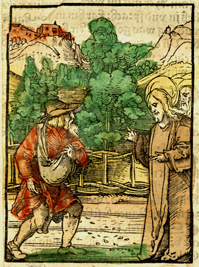
The picture: Jesus Teaches His Disciples, in Das Plenarium oder Ewangely Buoch, printed 1516. Courtesy of the Digital Image Archive, Pitts Theology Library, Candler School of Theology, Emory University.

Monday, March 31, 2008

"Your Son Lives" (John 4:46-54)

In John 4:46-54, John tells the story of Jesus healing the son of a nobleman of Capernaum. I used to think that this story was kind of plain vanilla, especially when compared with the stories nearby - Nicodemus, the Samaritan woman, and the paralytic of Jerusalem. But it turns out, as you might suspect, that there is more than meets the eye.
  1. In each scene, John shows Jesus confronting, replacing or fulfilling a major institution of Judaism. Jesus is compared with purification rituals and the Temple (ch. 2), with a great rabbi (ch. 3), with a sacred well (ch. 4), and with the sabbath (ch. 5). In this scene, Jesus is compared with the rulers of Israel.
  2. The story has similarities to the healing of the centurion's servant (Matt 8:5-9) in that it involves healing at a distance in Capernaum. The The Gospel of John, a great movie, depicts this scene as if it were the same as Matthew's. But John tells the story with a Herodian nobleman and his son, not a centurion and his servant.
  3. Most scenes in John show Jesus as the source of life, echoing the idea found in John 1:3-4. The nobleman says "come, before my child dies;" Jesus says "go, your son lives" (4:50); the servants say "his child lives" (4:52); the nobleman remembers that Jesus said "your son lives" (4:53). Repeating it three times, as well as ending the account with the saying, tells us that John thinks it is important: Jesus is the source of life.
  4. Jesus uses the same words as Elijah does when he raises the son of the widow of Zarephath (ze ho huios, in Greek; see LXX 1 Kings 17:22). This may be an intentional allusion. Jesus is elsewhere compared to Elijah; here, he is seen as greater than Elijah by healing at a distance. (Paul does something similar in Acts 20:7-12; see this post).
  5. John is encouraging faith, as he often does. Jesus begins by pointing out the shortfall of signs-based faith (John 4:48). The nobleman then "believed the word that Jesus said" before he saw the miracle (4:50); then "he himself believed" after seeing his son, along with his whole household (4:53). He is a model believer - his faith grows, and through him, others come to believe.
  6. Most scenes in John have a foreshadowing of the death of Jesus. This one doesn't, but I don't know why.

The picture: The Healing of the Official's Son, from Auslegung der Episteln vnd Euangelien..., by Martin Luther, published 1544 (Courtesy of the Digital Image Archive, Pitts Theology Library, Candler School of Theology, Emory University).

Tuesday, March 25, 2008

Why Three Days?

Why do the Gospel accounts emphasize that Jesus was dead three days? By my count, there are 26 references to the three days of Jesus' death in the New Testament. In Matt 12:40, Jesus gives us a hint about its significance: "For just as 'Jonah was three days and three nights in the belly of the whale,' so will the Son of Man be three days and three nights in the heart of the earth," quoting Jonah 1:17.

Another hint can be found in Luke 18:33, where Jesus says "they will kill him, and on the third day, he will rise." The phrase in italics is almost identical to Hosea 6:1-3 (in the LXX, the Greek Old Testament): "the Lord... has seized and he will heal us, he will strike and he will bandage us. He will heal us after two days, on the third day we will rise, and we will live before him."

These two Old Testament passages have something in common. Both of them, read in their orginal contexts, describe how God brought wrath on someone, but then rescued. Jonah cries out "I cried for help from the depth of Sheol [the grave]; you heard my voice... the earth with its bars was around me forever, but you have brought up my life from the pit" (Jonah 2:2-9). Hosea 6 in a similar way describes God's restoration of his people who experienced his wrath.

Jesus picks up this theme in his predictions of his death and resurrection. Like Jonah, Jesus would experience God's wrath, but after three days he would come up from "the depth of Sheol;" like Israel in Hosea, Jesus would be healed by the God who wounded. Jesus' prediction of "three days" was thus designed to recall these OT examples of faith that God would deliver; it probably also teaches that Jesus would suffer the wrath of God before his vindication and resurrection.

The picture above is a portrayal of the women at the empty tomb. It comes from The Brick Testament - a very interesting website, but occasionally rather warped.

Thursday, March 20, 2008

What did Jesus Teach After the Resurrection?

My friend wrote me a question about Jesus' post-resurrection teaching (by the way, feel free to post other questions and I will try to tackle them). Why is it that we have so much of Jesus' teaching before his death, but very little after his resurrection? First, let's list what we know about Jesus' teaching during those approximiately forty days:
  • Instructions to inform other disciples about his resurrection (Mt 28:10; John 20:17-18)
  • Demonstration that the resurrection was in a new body - thus showing that the new covenant age had begun (Lk 24:38-43; John 20:27)
  • Explanation of how Jesus' death and resurrection fulfills the OT prophecies (Lk 24:25-27, 44-46)
  • Blessing on those who believe in his resurrection (John 20:29)
  • Foundation of the church with people from all nations as disciples (aka the Great Commission) (Mt 28:19-20; Lk 24:47; Acts 1:8; John 20:21, 23)
  • Promise of the Holy Spirit and/or giving of the Holy Spirit (Lk 24:49; Acts 1:4-5, 8; John 20:22)
  • Restoration and re-appointment of Peter (John 21:15-19)
  • Unspecified teaching about the Kingdom of God (Acts 1:3)
  • Unknown time of the fully restored kingdom (Acts 1:6-7)
  • Promise to be with his disciples to the end (Matt 28:20)
Notice three basic categories. Jesus teaches about
  1. his death and resurrection (its nature, significance, and connection to the OT)
  2. the founding of the church (its nature, its source of power, and its human leadership)
  3. Jesus' return (the unknown time, the restoration of the kingdom, and Jesus' presence until then).

I'll post more on this topic in the next few days. I'd love to finish now, but my sons are informing me that it's time to begin a sacred Maundy Thursday ritual. It will be held at the Hawaiian Waters Adventure Park. :)

The picture above is a stained glass depiction of Jesus' appearance to Mary Magdalene. It is displayed in Trinity Church, New York, and was designed by by Sir Edward Burne-Jones in the late 1800s.